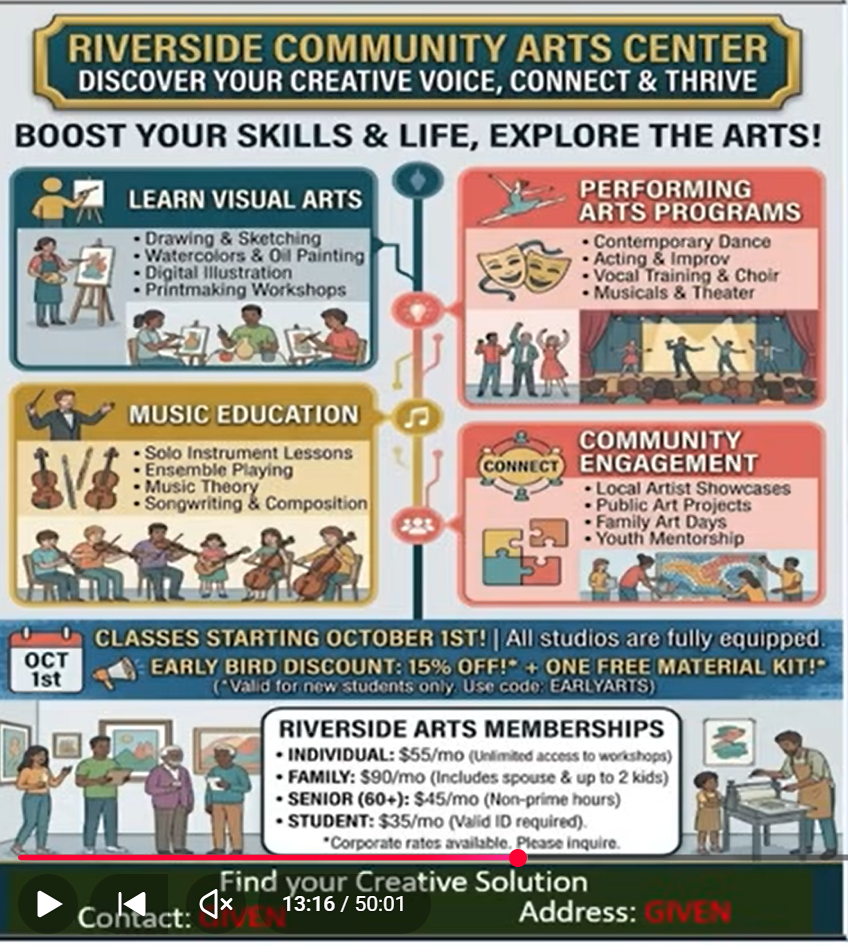
I hope you're doing well. I'm writing to you on behalf of the "cousins' committee" regarding the upcoming 40th-anniversary
celebration for Grandma and Grandpa this July. We've been reviewing the itinerary you sent over last night, and while we
all appreciate the incredible amount of effort you've put into scouting locations, there are a few logistical hurdles
we need to address before we put down any non-refundable deposits.
The primary concern is the choice of the Lakeside Heights Resort. While the view of the Okanagan is undoubtedly
spectacular, the "rustic charm" mentioned in the brochure seems to translate to a lack of elevators and several steep
gravel paths between the dining hall and the sleeping quarters. As you know, Grandpa's mobility has decreased
significantly since his hip surgery last autumn. Having him navigate those inclines in the summer heat might be more of
an ordeal than a celebration for him. We've looked into a secondary option ‐ The Grand Kelowna Urban Suites
‐ which offers full accessibility and a shuttle service to the waterfront. It lacks the "secluded forest" vibe,
but it ensures everyone can participate without physical strain.
Furthermore, regarding the "Black Tie" gala dinner you suggested for Saturday night: after polling the younger cousins,
many are traveling from overseas and are trying to pack light to avoid excess baggage fees on budget airlines. Carrying
formal suits and gowns across the Atlantic is proving to be a point of contention. Perhaps we could pivot to a
"Lakeside Elegant" theme? It would maintain the prestige of the event while allowing for more practical attire.
Lastly, about the catering budget. We noticed the quote from "Fine Vines Catering" doesn't include a breakdown for
dietary restrictions. Both Sarah's youngest and Cousin Leo have developed severe nut allergies recently. We need to
ensure the kitchen is a certified nut-free environment, rather than just offering a "nut-free option," as
cross-contamination is a deal-breaker for them.
Could we jump on a quick call this Sunday at 2:00 PM to discuss these pivots? We want this to be as seamless as
possible for the guest of honor, and we're happy to take over the communication with the new venue if you're feeling
overwhelmed by the coordination.
Warmly,
Cassie
SECTION 2
09:00
Reading Correspondence
Part 1: Read the following email with the attached diagram. Answer the questions by choosing the best word or phrase
to complete the sentence referring to the diagram when necessary.
SECTION 3: Reading for Information
10:00
The Language of Nature
A.
In 2007, the Oxford Junior Dictionary removed several nature-related words ‐ such as "acorn," "bluebell," and
"kingfisher" ‐ to make room for modern terms like "blog," "broadband," and "voicemail." This decision sparked
a global conversation about "nature deficit disorder" and the fading linguistic connection between children and the
outdoors. Linguists argue that if we don't have a specific name for a plant or animal, we are less likely to notice
it or care about its conservation. This phenomenon, known as "linguistic extinction," often precedes the actual
biological extinction of a species in a particular area.
B.
The "shifting baseline syndrome" is a psychological effect where each generation accepts the degraded natural world
they inherit as the "normal" state. Because young people no longer have the vocabulary to describe the abundance of
the past, they don't realize what has been lost. For example, a child might see a "bird," but if they don't know the
word "lark" or "thrush," the specific identity and behavior of that creature become invisible. Educators are now
calling for a "re-wilding" of the curriculum, emphasizing outdoor literacy as a core skill alongside math and
reading.
C.
Indigenous languages are a treasure trove of "ecological knowledge" that is often untranslatable into English. Some
languages have dozens of specific words for different types of snow, or for the exact moment a particular flower blooms.
This precision allows for a sophisticated management of natural resources. When these languages die out, we lose
thousands of years of observations about local ecosystems. Efforts are underway to create "bio-cultural dictionaries"
that preserve this knowledge before the last native speakers pass away.
D.
Art and literature are playing a key role in the revival of these lost words. Books like The Lost Words by Robert Macfarlane
use poetry and illustration to "conjure" these terms back into the public consciousness. These works are now being used in
hospitals and care homes to help patients reconnect with their memories and the world around them. The goal is to prove that
language is not just a tool for communication, but a "way of seeing." By reclaiming our vocabulary of the earth, we might
find the motivation to save the earth itself.
E. Not given in any of the above paragraphs.
SECTION 4: Reading for Viewpoints: The Space Race
13:00
The era of "The Space Race" was once a battle between superpowers for scientific prestige. Today, the theater of operation
has shifted to the private sector, with billionaire-led companies offering suborbital flights to the ultra-wealthy. While
proponents argue that space tourism is the necessary first step toward becoming a multi-planetary species, critics see it
as a grotesque display of inequality and a catastrophic threat to the environment.
Advocates of the private space industry argue that tourism is the engine that will drive down the cost of space flight. Just
as early aviation was a luxury for the rich before becoming a standard mode of transport for the masses, space tourism
provides the capital needed for research and development. This innovation leads to "spinoff" technologies ‐ advances
in materials science, satellite communications, and life-support systems that benefit everyone on Earth. Furthermore,
proponents highlight the "Overview Effect" ‐ the profound cognitive shift experienced by astronauts when they see the
Earth from space. They argue that if the world's most influential leaders and citizens see the fragility of our planet
firsthand, they will return with a renewed commitment to environmental protection and global peace.
Moreover, the commercialization of space opens the door for asteroid mining and orbital manufacturing. By moving heavy,
polluting industries off-planet, we could potentially save the Earth's biosphere from further degradation.
On the other hand, the environmental cost of a single rocket launch is immense. Critics point out that the carbon emissions
and soot released into the upper atmosphere by these flights are significantly higher per passenger than any commercial jet.
At a time when the world is being told to reduce its carbon footprint, the idea of burning tons of fuel for a ten-minute
"joyride" seems ecologically irresponsible.
Beyond the environmental impact, there is the moral argument of "opportunity cost." Critics ask: why are we spending
billions to send celebrities into the thermosphere when we face existential crises like climate change, famine, and
preventable disease on the ground? The sight of a rocket rising above a planet struggling with historic droughts and
wildfires strikes many as a symbol of a detached elite. There is also the growing problem of "space junk" ‐
thousands of pieces of orbital debris that threaten the satellites we rely on for GPS, weather forecasting, and global
telecommunications.
The debate over space tourism is ultimately a debate over humanity's priorities. Are we a species meant to explore the
stars at any cost, or should we master the art of living sustainably on our home planet before we look toward the heavens?
Questions: Section 1
- Part 1
Location: Vadodara, Gujarat
Renuka Nair, a former banker is the founder of Panache IELTS. She was born and raised in Mumbai and did
her schooling
from Apostolic Carmel Convent, a school that believed in holistic education. Despite Malayalam being her
mother tongue,
English was her first language of education. The nuances of grammar were inculcated in her during her
formative years,
along with creative writing. It was while she was pursuing her Bachelor's degree that she decided to
hone her vocabulary.
Having completed her Masters in Mathematics and Computer Science, she started her career in Vadodara,
Gujarat in NIIT,
teaching C++ to Engineering students. This was followed by 15 years in the Banking Industry, during the
course of which
she obtained a PG diploma in Finance. Wanting to start out on her own, she quit banking in 2012 and
started training
professionals initially in Corporate Communications, followed by Spoken English and eventually IELTS,
CELPIP, TOEFL, GMAT, and
so on.
Our tutor takes pains to explain the IELTS/TOEFL/CAT/GMAT Reading task to students and we ensure
weak students understand this
task and are comfortable with it before conducting mock tests.
A Variety of Listening Tests
We have a repertoire of Listening Tests that cover all sections from long MCQs to Maps, and
confusing Fill-ups in IELTS, and other
English profeciency exams.
Speaking
We conduct one-on-one speaking sessions daily with our students, as a result of which even
vernacular students get
their desired bands.
Writing
We encourage our students to practice writing daily. Their writing is thoroghly checked and errors
are pointed out.
We also suggest unique vocabulary to ensure our students stand out.